

In the healthcare facility, every material used, from furniture to medical equipment to surgical instruments, plays a key role.
It is thus important to choose equipment made from premium quality to ensure safety, hygiene and durability. Here comes the role of the most commonly used grades – 304 v/s 316 stainless steel.
Choosing between them can directly impact infection control, maintenance costs and equipment lifespan. It is important to understand the difference between 304 and 316 Stainless Steel to control infection, maintain costs and lifespan of the equipment.
Understanding differences is important to maintain the highest standards of patient care and compliance.
What is 304 Stainless Steel?
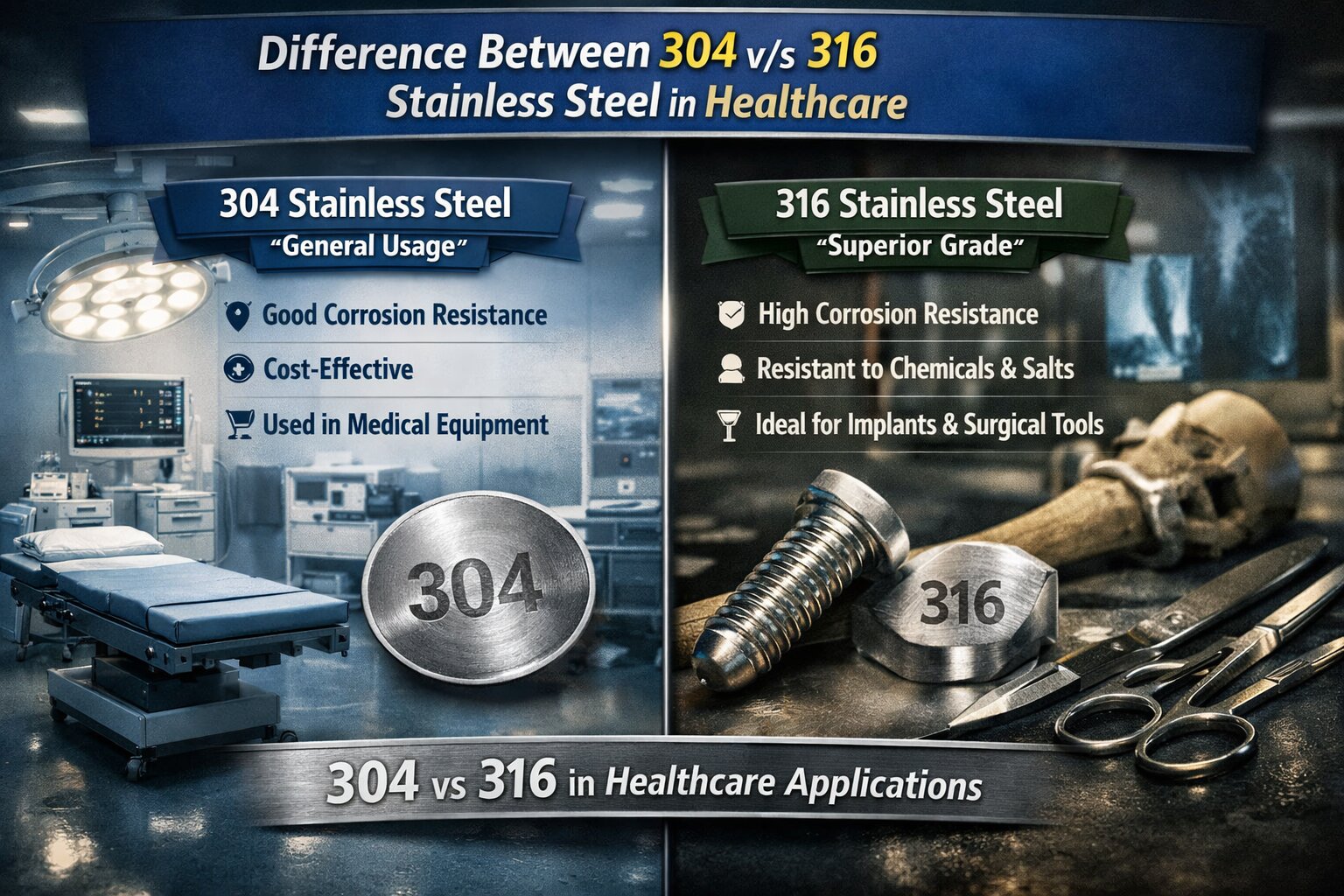
304 Stainless Steel (SS) is the most widely used stainless steel grade in healthcare and general industries.
It contains approx. 19% Chromium and 8 % Nickel, which gives it excellent corrosion resistance and durability.
The 304 SS stands out for strong resistance to oxidation and rust, is cost-effective for mass production, easy to clean and apt for general healthcare environments.
It is commonly used in hospital furniture, trays, storage units and non-critical medical equipment.
What is 316 Stainless Steel?
When understanding medical grade stainless steel 304 v/s 316, it is equally important to understand the features of 316 SS.
It is an upgraded version of 304. It contains molybdenum in addition to chromium and nickel.
This added element improves its resistance to corrosion, especially in harsh environments.
The key features of 316 SS include superior resistance to chemicals and a saline environment, as well as long-lasting performance under extreme conditions. It is best for repeated sterilizations and ideal for critical medical applications.
It is widely used in surgical instruments, implants and environments exposed to body fluids or aggressive disinfectants.
Stainless Steel 304 v/s 316 Comparison
- Composition and Material Structure: The main difference between 304 and 316 SS lies in their chemical composition. 304 SS contains chromium and nickel, making it highly resistant to oxidation. 316 SS includes an additional element, molybdenum, which enhances its resistance to corrosion against chlorides and harsh chemicals. This addition of composition in 316 SS makes a huge difference in performance, particularly in healthcare, marine and chemical industries where exposure to aggressive substances is common.
- Corrosion Resistance: When considering 304 v/s 316 corrosion resistance, 304 SS performs well in dry or mildly corrosive environments, making it ideal for indoor applications. However, it can be prone to rust when exposed to salt, chemicals and disinfectants over time. 316 SS offers superior resistance to corrosion due to the presence of molybdenum. It performs exceptionally well in chloride-rich environments – hospitals, laboratories and coastal areas, ensuring durability and reduced maintenance.
- Strength: When considering 304 v/s 316 strength comparisons, both are strong, durable and capable of handling heavy –duty applications. 316 SS has a slight edge in terms of long-term durability under extreme conditions. While 304 SS is sufficient for daily applications, 316 SS is better suited for environments that involve frequent exposure to moisture, chemicals and high temperature. Its increased resistance helps maintain structural integrity over time, making it a reliable choice for critical applications where performance cannot be compromised.
- Cost and Economic Value: When thinking of the 304 v/s 316 cost difference, 304 SS is more affordable and widely available, making it a go-to choice for large-scale applications where budget is the main concern. In contrast, 316 SS is more expensive due to the addition of molybdenum and its great properties. Higher initial investment in 316 SS can be justified by its longer lifespan, lower maintenance costs and better performance in harsh environments, offering better value over time.
304 v/s 316 Stainless Steel in Healthcare- Quick Comparison
| Parameter | 304 SS | 316 SS |
| Corrosion Resistance | Good | Excellent |
| Strength | Strong and Durable | Slightly stronger in harsh conditions |
| Cost | Lower cost | Higher cost |
| Composition | Chromium + Nickel | Chormium+Nickel and Molybdenum |
| Best Use | General use Furniture | Medical, marine and chemical environments |
Which one to choose- 304 SS v/s 316 SS
- Choose 304 SS for cost-effective applications. Hospitals, commercial kitchens and furniture manufacturers prefer 304 SS for non-critical equipment as it delivers reliable performance at a lower cost, is easy to maintain and widely available.
- When your application involves exposure to salt, moisture or harsh chemicals, 316 SS is a compelling option. As the molybdenum content provides great protection against corrosion, it is highly suitable for healthcare facilities, marine environments and laboratories. If hygiene and durability are key factors, investing in 316 SS ensures good resistance, minimizing the risk of material degradation over time.
- Hygienic Level: In healthcare facilities, healthcare industries and pharmaceuticals, hygiene is non- negotiable. 316 SS performs better under frequent sterilization and exposure to harsh chemicals, making it ideal for surgical instruments and critical equipment. For areas with minimal chemical exposure, 304 SS can still meet hygienic standards effectively when maintained properly.
- Long-Term Value v/s Initial Cost: 316 SS is more expensive upfront, but proves more cost-effective in the long run due to its durability and lower maintenance needs. 304 SS offers immediate cost savings but may require more frequent replacements in harsh environments.
- Usage: The right choice depends on where and how the material will be used. For general indoor applications, 304 SS is sufficient. If the material is used in demanding conditions involving moisture, chemicals and strict hygiene standards, 316 SS is a smarter and more reliable investment.
Choosing between 304 and 316 Stainless Steel is a key decision that impacts patient safety, hygiene standards and operational efficiency. 304
SS offers more affordability and versatility, and 316 SS delivers unmatched performance in demanding healthcare environments.
FAQs
- Which stainless steel is better for medical use?
316 Stainless Steel offers better corrosion resistance and the ability to withstand harsh sterilization conditions. United Poly manufactures premium quality 316 SS medical equipment and tools according to your healthcare facility’s needs. - Why is 316 SS more expensive?
316 SS contains molybdenum, which increases corrosion resistance and also material cost. - Which stainless steel is cost-effective?
304 SS is more cost-effective due to its lower material cost, making it ideal for general-purpose applications. United Poly is the dedicated supplier and exporter of premium-quality medical equipment.
About Author
United Poly is a reliable manufacturer of premium-quality medical furniture and equipment, backed by over two decades of industry experience.
The brand is known for its durable products, precision engineering and strong focus on healthcare norms and hygiene.
Driven by a customer-focused approach, innovation and sustainability, United Poly provides solutions designed to meet the changing needs of modern medical environments.